Headway - Daily Micro Learning
- 4.5
- Rating
- 10.00M
- Installs
- Free
- Price

 Analysis by App-foxy
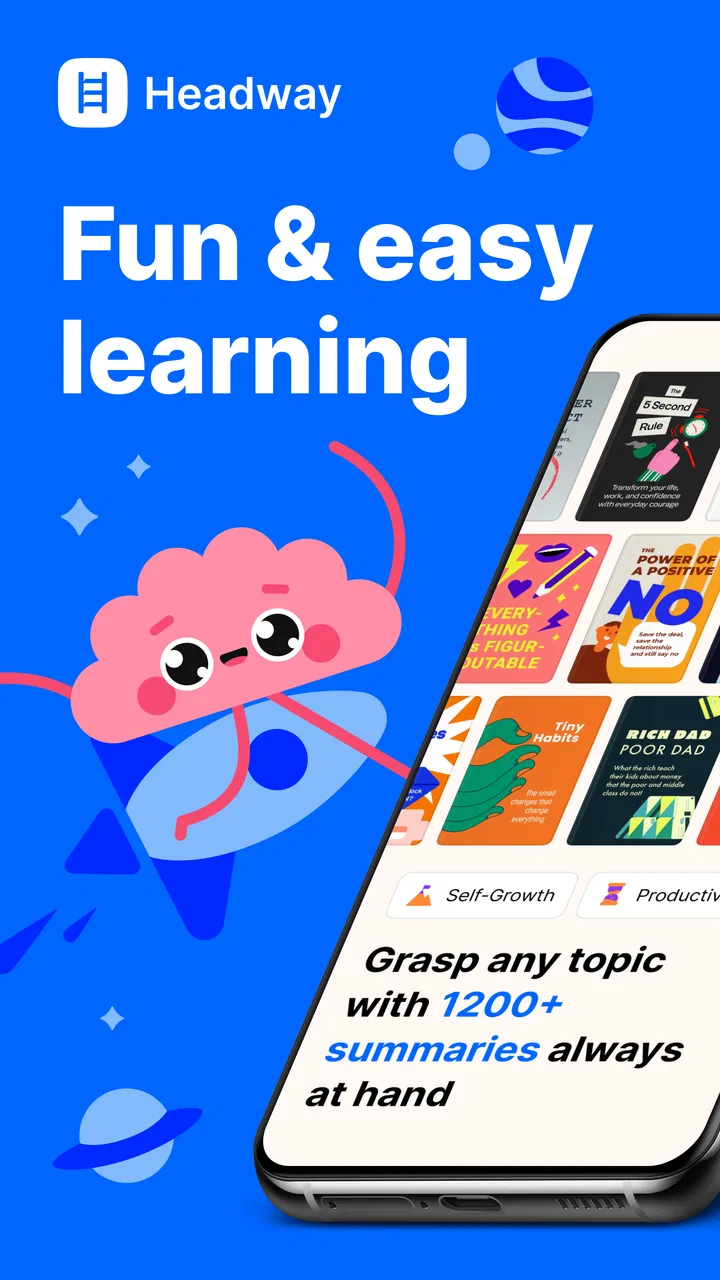
Headway - Daily Micro Learning is the kind of education app I open when I want to learn something useful but do not have the energy for a full book. It turns major ideas from nonfiction reading into short lessons, making it easier to fit learning around a commute, a lunch break, or a few quiet minutes before bed. I found the format approachable, although it works best when I treat it as a starting point rather than a complete replacement for reading.
Developed by Books Made Easy Corp, this free education app is aimed at teenagers and older users who want a more regular learning habit. It has an average rating of 4.6 from around 162 thousand ratings, and its audience has taken it well beyond a niche study tool, with over 10 million installs. Those figures suggest strong interest, but they do not remove the need to decide whether condensed learning actually suits the way you absorb ideas.
What using Headway feels like in everyday life
My first impression was that the app is built around momentum. Instead of asking me to reserve an hour for a book, it presents knowledge in smaller portions that feel easier to begin. That matters because the hardest part of self-education is often not understanding a topic; it is getting past the first few minutes of resistance.
You May Also Like

 Blood Strike: 2.5 Anniversary
Blood Strike’s Loadouts Turn Every Drop Into a Tactical Gamble
A close look at Blood Strike’s custom loadouts: how fast access to signature weapons reshapes its battle royale rhythm, rewards preparation, and narrows the gap between fights.

 Pandora - Music & Podcasts
Pandora’s Music Is Easy to Start, but Harder to Recover
Pandora’s strength is its low-effort path from a seed to a station. Its weak spot is how much confidence it asks you to place in connection, setup, and quiet recovery.

 8 Ball Pool
 Is Built on Rivalries, Rematches, and Routine
A close look at the rivalries, rematches, shared routines, and unanswered safety questions that turn a quick pool match into a persistent mobile community.

 Samsung Music
’s Quiet Strength Is Playing What You Already Own
Its reach comes less from spectacle than from dependable access to a personal library. That simplicity is both the app’s strongest retention engine and its ceiling.

 AccuWeather: Weather Radar
AccuWeather Review: A Quick, Clear Forecast for Everyday Decisions
For everyday plans, the best forecast is the one you can understand quickly. AccuWeather makes rain timing, radar, and local conditions easy to act on, with a few trade-offs.

 Hill Climb Racing
Why Hill Climb Racing Still Turns Crashes Into One More Run
A tiny car, a bumpy hill and one more upgrade: Hill Climb Racing keeps resurfacing because its simple chaos makes every near-miss feel personal.
More From Our News Desk



The central appeal is simple: I can explore an idea, take away a few practical points, and move on without carrying a large reading commitment. This makes it particularly useful for someone who scrolls through a phone during spare moments and wants to replace some of that time with something more deliberate. It is less suitable for a student who needs detailed source material, citations, or a complete argument from beginning to end.
I would describe it as a guided overview service rather than a digital library. That distinction is important. A condensed lesson can help me decide whether a subject deserves deeper attention, remind me of a principle I have already encountered, or give me a vocabulary for thinking about a problem. It cannot always preserve every qualification, example, or disagreement that appears in a full-length work.
Where people usually get stuck
The first point of friction is expectation. Someone may install the app expecting a conventional reading platform, then feel disappointed when the experience is built around brief learning sessions. I had better results when I approached each lesson as a map of the main ideas, not as a substitute for the original book.
Another common stumbling block is choosing too much at once. A large selection can make the app feel productive before any learning has happened. I prefer picking one subject that connects to something I am currently doing, such as communication, work habits, or decision-making. A relevant lesson is easier to remember than a random sequence chosen only because it looks interesting.
There is also a subtle difference between finishing a lesson and learning from it. Short content can create a satisfying sense of progress, but completion alone does not guarantee retention. I get more value when I pause after a section and write down one action or question. That tiny interruption turns passive scrolling into a more active study routine.
Notifications and reminders can create a similar trade-off. A prompt may help establish consistency, but too many interruptions can make the app feel like another obligation. If the routine starts to feel noisy, I would reduce the distractions rather than abandon the learning habit entirely. The goal is a sustainable rhythm, not a perfect streak.
Setup checks before blaming the app
Before judging the experience, I would check the basics. The current version is 3.150.0 and the minimum operating system is Android 9, so an older device may be the real reason for installation or performance trouble. On a compatible phone, I would first close other demanding apps, restart the device, and make sure the app has been updated through the normal store process.
If the first session feels confusing, I would slow down and inspect the choices shown during setup rather than tapping through them automatically. Early selections can influence how useful the recommendations feel. Giving honest answers is more helpful than selecting every appealing topic, because a narrower starting point usually produces a clearer learning path.
A stable connection is also worth checking when content does not load as expected. I would switch between Wi-Fi and mobile data, try again after reopening the app, and confirm that the phone itself can reach other online services. These are ordinary checks, but they separate a temporary connection problem from an issue with the learning experience.
Storage can matter as well, particularly on a phone that is nearly full. I would leave some room for normal app operation and avoid repeatedly reinstalling the app as a first response. Reinstallation can remove local state without addressing a weak connection, an outdated operating system, or an account-related problem.
Because Headway is free to download but includes optional purchases ranging from $0.99 to $399.99 per item, I would read each payment screen carefully before confirming anything. The useful habit here is simple: do not assume that a free installation means every part of the experience is included at no cost. I would also check the purchase wording and confirmation details rather than relying on a quick tap.
Recovering a routine when progress feels scattered
When I lose track of what I have learned, I do not try to consume more lessons to compensate. I return to a single theme and review my notes, then choose one practical experiment for the week. For example, after learning about communication, I might focus on asking clearer questions in one meeting instead of opening several unrelated topics.
This approach exposes one of the app's strengths: it can act as a prompt for behavior change. The short format gives me enough material to begin a conversation with myself, but the real benefit comes from applying one idea outside the screen. If I only collect summaries, the app becomes another form of scrolling.
A useful workflow is to keep a small note with three lines: the main idea, where it may apply, and what I will test. I would not copy every sentence. Selecting one idea forces a decision about what was genuinely valuable, and that makes later review much faster. It also helps reveal when a lesson was interesting but not relevant to my current goals.
If a session stops loading or behaves oddly, I would recover in stages: leave the screen, reopen the app, test another lesson, and check the connection. If only one item is affected, the problem may be limited to that piece of content rather than the whole application. If everything is affected, device compatibility, connectivity, or account state deserves attention before I conclude that the service is unusable.
I also recommend avoiding a rushed catch-up session. Trying to clear a backlog turns a flexible learning tool into a task list. A better reset is to choose a modest daily target and allow older material to remain unfinished. The app is more valuable when it supports curiosity than when it creates guilt.
When the app is not the cause
Some frustration comes from the mismatch between a user's goal and the format. If I need to master a technical subject, prepare for an exam, or understand a book's evidence in detail, I would choose a textbook, course, or full audiobook instead. Summaries can orient me, but they are not a reliable replacement for structured instruction or primary sources.
The same applies when I want a quiet, uninterrupted reading experience. People who prefer long chapters, extensive notes, and control over the order of material may find short lessons too compressed. A conventional ebook reader is better for that purpose because it keeps the complete text in view and does not ask me to jump between brief ideas.
On the other hand, someone who struggles to start books may find this approach more realistic than a large digital library. The app lowers the commitment required to begin, and that can be enough to turn an occasional intention into a repeatable habit. I would especially recommend it to busy adults, curious beginners, and people who want prompts for personal development without planning a formal study schedule.
It is also worth separating device problems from content preferences. If the app is slow only on an older phone, the operating system or available resources may be responsible. If lessons open normally but feel too shallow, that is not a technical failure; it is a format decision. Recognizing that difference saves time and leads to a more honest verdict.
How it compares with ordinary alternatives
Compared with reading full books, Headway is faster to sample and easier to fit into fragmented time, but it gives up depth and context. I use it to decide what deserves deeper attention, refresh a familiar concept, or find a practical starting point. I would not use it as my only source when a subject has important nuance or when I need to evaluate an author's complete reasoning.
Compared with podcasts and long-form videos, the short lesson format can be easier to revisit because the information is presented in a more concentrated way. Audio is still better when my eyes are occupied, such as during a walk or household task. Headway suits moments when I can look at the screen and want a more intentional alternative to ordinary social scrolling.
Compared with taking a course, the app is less demanding and more flexible, but it offers less accountability and usually requires more self-direction from me. A course may provide exercises, deadlines, and a clear progression. Headway is better for exploration, habit building, and discovering subjects before committing to a larger learning plan.
That makes the app complementary rather than universally superior. I can use a short lesson to identify a useful concept, then move to a full book, lecture, or class when I need evidence and detail. This two-step workflow is, in my opinion, more sensible than expecting any condensed-learning product to do every job.
Who will get the most from it
I think the strongest audience is someone who already has spare scrolling time but finds traditional study difficult to start. The app gives that person a clear first step without demanding a large block of free time. It can also suit readers who want a broad tour across personal growth, communication, and related educational subjects before choosing a deeper path.
It is less convincing for users who dislike summaries on principle, need formal academic material, or want every conclusion supported by extensive detail. I would also be cautious if you are motivated mainly by collecting completed lessons. The format rewards consistency and reflection, not speed alone.
Teen users should remember that the content rating is Teen, so families may want to consider whether the topics and presentation match the younger user's needs. Adults can treat that rating as a useful reminder that this is an educational product for a general mature audience, not a children's reading app.
The developer, Books Made Easy Corp, has created a product with a clear identity: compact learning for people who want knowledge to fit around ordinary life. Its 4.6 average and broad adoption show that the approach resonates, but my recommendation still depends on how you define learning. If learning means discovering ideas and building prompts for action, it performs well. If learning means mastering a subject comprehensively, I would pair it with something deeper.
My practical verdict after using it
I recommend Headway - Daily Micro Learning to anyone who wants a low-pressure way to replace part of their idle phone time with useful ideas. The free entry point makes it easy to try, and the short format removes the intimidation of opening a long book when I have only a few minutes. Its best role is a launchpad for learning, not a final destination.
My main advice is to choose one relevant topic, take brief notes, and apply one idea before moving on. Check compatibility and connection issues before assuming the app is broken, and treat optional purchases with the same care as any other in-app transaction. Those small habits make the experience clearer and prevent the most common disappointment: mistaking a convenient summary for complete understanding.
For me, the deciding question is not whether the app can replace every educational alternative. It cannot, and it does not need to. The better question is whether it can help you begin. If the answer is yes, this education app offers a practical bridge between endless scrolling and a more deliberate daily routine. If you already have a strong reading system or need academic depth, your time may be better spent with full texts or structured courses.
FAQs for Headway - Daily Micro Learning
01What is Headway - Daily Micro Learning and how does it work?
Headway is an educational app that offers bite-sized learning experiences, perfect for those with busy schedules. It provides summaries of popular non-fiction books, allowing users to gain insights and knowledge quickly. The app organizes content into daily 15-minute reads or audio segments, making learning convenient and accessible.
02Is Headway suitable for all age groups?
Headway is designed primarily for adults and young adults who are interested in personal development, self-improvement, and professional growth. While the app is user-friendly and contains valuable content, it might not be fully engaging or appropriate for younger children due to its focus on adult-oriented topics.
03Can I use Headway offline?
Yes, Headway allows users to download content for offline use. This feature is particularly beneficial for those who want to learn on the go without relying on an internet connection. Simply download the content while online, and access it anytime, regardless of connectivity.
04What kind of topics does Headway cover?
Headway covers a wide range of topics including self-help, productivity, leadership, psychology, and health. The app curates content from best-selling non-fiction books, providing users with diverse learning opportunities to enhance their personal and professional lives.
05Does Headway offer a free trial or subscription model?
Headway offers a free trial period for new users to explore the app’s features. After the trial, users can choose from various subscription plans, including monthly or annual options, to gain unlimited access to the app’s content. Pricing details are available in the app store.
Pros
- User-friendly interface enhances usability.
- Wide range of topics for diverse interests.
- Short lessons fit into busy schedules.
- Offline access for learning on the go.
- Regular updates keep content fresh.
Cons
- Limited free content without subscription.
- Audio quality varies across lessons.
- Some topics need more in-depth coverage.
- Occasional app crashes reported by users.
- Requires internet for initial downloads.

Headway - Daily Micro Learning
Gallery